|
Hawaii is a group of islands in the Pacific Ocean, forming the northern tip
of Polynesia. The peoples of Polynesia share similar languages and their
cultures extend into prehistory. Long before Captain Cook claimed to
discover the islands in 1788, Polynesian people had developed complex
systems of social conduct, community development and spiritual evolution ...
all called witchcraft by Christian priests.
|
 |
Pu'uhonua Honaunau
- a famous sanctuary of pre-Christian Hawaii - has been
partially restored. It is about 30 km south of Kailua-Kona. This
image shows the Hale o Keawe (built around 1650) at sunset on
Honaunau Bay. It is a wonderful location for
ho'oponopono. |
Where did the Polynesians come from? Most anthropologists agree that
Polynesians are related to the Melanesian races of Australia and Malaysia. Some
writers claim that the Polynesians were influenced by Phoenician voyagers from
North Africa, due to correlations between Polynesian and old African languages,
and between Polynesian myths and the Hebrew bible.
A few people contend that
Polynesians are descended from the inhabitants
of a lost continent called Mu, which sank beneath the Pacific Ocean.
Thor Heyerdahl claimed Polynesians were influenced by the South American Maya.
Some people say they were a lost tribe of Israel. Theories are plentiful.
Huna is a name recently given
to the healing and mystical practices of ancient Hawaii. An expert was
called a kahuna, literally kahu-na “a keeper of balance”. Older
names for these shamanic practices included ho'omana and ho'omanamana,
meaning the making and use of mana or power.
Ho'omana was
developed in isolated communities called 'ohana. The chiefs (ali'i)
controlled communities with the help of kahuna,
who maintained stability by enforcing a strict kapu
(taboo) system, honoring the ancestors (kupuna),
guardian spirits (aumakua and awaiku) and gods (akua).
Most chiefly families were considered to be kalani -
descendents of gods - and their words were law.
|
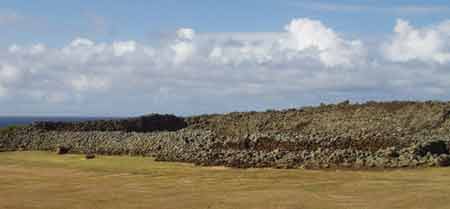
Mo'okini Heiau, Kohala, Hawai'i
Remains to be scene |
 |
A kahuna was an expert, trained from childhood for many
years. As there was no written language; knowledge was primarily transmitted
verbally. Important information was usually taught in chants. Mistakes in
chanting were believed to insult the gods or ancestors, the chiefs or the
gods, and a forgetful chanter could be severely punished. This encouraged
exact learning.
Unlike the complexity and chaos of our modern Western societies,
life in a Hawaiian ohana was simple and stable, based on common values
of pono (righteousness) and na (harmony). Many of the old Hawaiian
kapu customs and rituals would be inappropriate for Westerners.
For example, it was a crime for a woman to eat most species of
banana and it was generally believed that an offender would die.
Hawaiian spirituality was created and preserved by people living in small
communities, and huna from different parts of Hawaii is different.
The heart of the old teachings, aloha (literally - we breathe together)
offers a basis for creating 'ohana suitable for our own world. As we translated Hawaiian
healing magic into Western intellectual tradition - Soulwork systemic solutions
became manifest.
Unlike the complex mystical systems developed in ancient cultures
such as Egypt, China and India,
Huna is simple to understand and use.
However, even in modern Hawaii there remains much secrecy.
Few native kahuna will teach non-Hawaiians and few native
Hawaiians will admit to knowing much about this ancient wisdom.
As a native Hawaiian friend said, “The haole (white immigrants) stole our
land and they stole our children; now they want to steal our soul!”
Pre-Christian rituals survive on other Polynesian islands.
Old traditions of New Zealand, Tahiti or Easter Island are different, although
the names of many gods and rituals are easily recognizable to Hawaiians.
Hawaiian spirituality includes the Order of Ku, concerned with the power
of emotions and wild places. The Order of Lono was concerned
with the power of the intellect, such as agriculture and house
building, and the Order of Kane
concerned spiritual and community development.
Could this be a step on your path? There are three
keys: the purity of your integrity, the clarity of your intent and the
application of your knowledge. To make space for joyful learning,
we can share Hawaiian traditions. Each of us has qualities that
may assist other people in their lives - and if “your qualities
are our qualities” and “our qualities are your qualities”,
then we can recreate 'ohana. The heart of Huna Kalani is to live
in a stable, peaceful community, with love and joy, in balance with nature.
Maki'iki'i, e Maki'i-lohelohe
Aia i 'ele e ka mauna
Oia i 'ele e ka moana
Ma kai 'ouli ma kai akea
Ki’eki’e ka hoku, ha'aha'a ka malama
E ka 'ohiki, e ka 'ohiki pae |
Maki'iki'i, Maki'i-lohelohe
Darkness is over the mountain
Darkness is over the ocean
At sea is an omen, in the wide sea
The stars are high, the moon is low
Let that which is unknown be known! |
Mahalo - amama,
Martyn Kahekili Carruthers
Hawaiian Spirituality .
Ho'oponopono .
Healing and Ohana .
Kumulipo .
Hawaiian Shamanism
Will you join us under the trees
by Kealakekua Bay? Will you come with us into the craters in Volcano
Park? Or will you help us come to you? We bring these teachings
to the world under their old name of Huna Kalani, and under our
new name of
Soulwork.
Consider joining us in Hawaii. Our
classrooms are beaches, forests and volcanoes. We can help you make
Hawaii a journey of a lifetime. Stay in South Kona and come with us to
the most beautiful, most sacred (and most haunted) places on Big Island.
Hawaiian
Shamanism .
Hawaiian Angels
. Hawaii Big Island
Huna was a word used by native Hawaiians to describe lost or
hidden things. Max Freedom Long probably chose this word due to confusion
with the word kahuna, (kahu na - keeper of balance) which was
used to indicate an expert or a sorcerer. Native Hawaiian life was more
concerned with pono (righteousness), aloha (love) and mana
(power).
Our Huna Kalani provides an experiential introduction to old
Hawaiian shamanism. You can experience the beauty and power of our research
in a series of workshops that can expand your perception of reality.
Hawaiian magic refers to a technology of consciousness that few understand. Within
this old healing magic are some of the roots of the systemic magic
of Soulwork systemic coaching.
|
Training in Hawaiian Shamanism |
|
Huna 1 |
Bringing Down the Sun: Ho'oponopono
& Ho'omanamana |
|
Huna 2 |
Elements of Nature: Honua, Ha, Ahi & Wai |
|
Huna 3 |
Dreamtime: Ho'omoe, Moe Uhane & Expanded Consciousness |
|
Huna 4 |
Advanced Huna of I'o, Kumulipo and
Awaiku |
|
Huna 5 |
Huna Experience in Croatia, Mexico or on
Hawaii |
Online Huna & Ho'oponopono .
Hawaiian Shamanism
Plagiarism is theft. Copyright ©
Martyn Carruthers 1997-2011 |