|
What good is a belief if it does not
benefit your life?
(Phineas Parkhurst Quimby, 1862)
We offer online coaching, dynamic talks
and professional training on resolving
relationship entanglements,
self-sabotage and psychosomatic disease.
See:
The Quimby Connection Training
Mesmerized
About the time of the American Revolution, there was in Paris
a Swiss physician from Vienna by the name of Dr Anton Mesmer. Dr Mesmer was
the sensation and scandal of his day, for he cured all manner of disease by
strange and unorthodox methods. Although later denounced by a team of
scientists (that included Benjamin Franklin), Dr Mesmer's teachings and methods
drew many students, some of whom presented performances of mesmerism. Around
1830, a clock-maker from Portland, Maine attended such a performance,
became a mesmerist and later the most well known mental healer
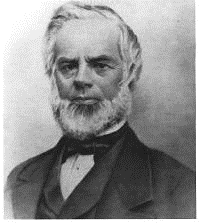
in America. His name was Phineas Parkhurst Quimby.
|
After developing his science of healing, Phineas
Quimby was credited for healing about a thousand people each year for
around fifteen years. Phineas Quimby died in 1866, after documenting
his opinions, beliefs and techniques in his manuscripts.
Quimby wrote that his science of healing was opposed
to both religion and medicine, which he perceived as the main sources
of wrong beliefs which caused disease. Quimby proposed a Christianity
aligned with his healing science.
|
 |
In 1863, Quimby loaned his unpublished manuscripts to
a patient, Mary Patterson, who would not return them. Mary Patterson
later married twice, to become Mary Baker and then Mary Baker Eddy,
known for founding the Christian Science healing church. After a
long and bitter controversy, Mary Baker Eddy's family returned Quimby's
manuscripts to Quimby's family, and only in 1921 could 'The Quimby Manuscripts'
be finally published in book form.
Quimby described a philosophy of healing, using spiritual
metaphors. In the following extract, Quimby uses a metaphor of daguerreotypes
for what is now called the unconscious mind. (Quimby worked with daguerreotypes
as a youth, you may have seen these early photographs in museums - made on copper
plates sensitized with chemicals). Here, writing in the third person, Quimby
speaks for himself:
Quimby's Silent Healing
"A patient comes in to
see Dr Quimby. He (Dr Quimby) renders himself absent to everything but
the impression of the patient's feelings. These are quickly
daguerreotyped on him. They contain no intelligence, but shadow forth a
reflection of themselves which he looks at: this contains the disease as it
appears to the patient. Being confident that it is the shadow of a false
idea, he is not afraid of it, but laughs at it. Then his feelings in
regard to the disease, which are health and strength, are daguerreotyped on
the receptive-plate of the patient, which also throws forth a shadow.
The patient, seeing this shadow of the disease in a new light, gains
confidence. This change of feeling is daguerreotyped on the doctor
again, and this [new impression] also throws forth a shadow, and he sees the
change and continues to treat it the same way. So the patient's feelings
sympathize with his, the shadow grows dim, and finally light takes its place,
and there is nothing left of the disease."
The essence of this method, Quimby implies, is to feel
a person's disease, create an image that
represents the person's beliefs about it, and change the image,
repeating this until the patient changes their beliefs about their disease.
Quimby was credited with healing many thousands of people with this
method - which he called the Silent Cure.
If you want to test this method, note that rapport with
sick people can cause you to experience their symptoms. I suggest that you
first find resources for your own good health, and that you have a
trained baby-sitter (oops, I mean coach) assist you. Quimby used a resource
that he called the Principle of
Goodness and a number of important presuppositions as guides.
Perhaps the most useful of Quimby's presuppositions is that "people can heal
themselves, if they have both motivation and means".
Quimby wrote that 70% of disease was caused by wrong beliefs.
I asked some physicians about their experience and was told that at least 50% of their
patients had disease that was either lifestyle-based or that was worsened by their
patients expectations. In this light, helping a client change their beliefs about
disease is as important now as it was in Quimby's day.
I used Quimby's descriptions to produce an interesting
strategy for changing beliefs (before I understood how people cling to limiting
beliefs as a way to maintain important but difficult relationships). The
following is an extremely brief summary of one part of Quimby's work. Quimby Belief Change Strategy*
Ask if this person wants healthy beliefs to support a
healthy life. -
Ask person to identify the benefits of a disease
and how to keep them.
Ask person to recall resourceful memories of good health, strength and laughter. Help person identify their limiting beliefs about their disease. Help person decide what he or she wants to believe instead. Ask person to describe both old and new beliefs as symbols.
Test person's new beliefs about their disease or
life situation.
I explored Quimby's methods around 1990, and found that my interpretations
of Quimby's methods produced useful and simple methods for coaching people to
change terrible limiting beliefs. Around 1994
I worked with Annegret Meyer (now Annegret Hallanzy), a family therapist
near Munich, Germany) to integrate Quimby's ideas into an overall model for effective
long term change, which I called Soulwork Systemic
Coaching.
|
You asked me what I believed about my
disease - and what those beliefs looked like. You kept talking for a few minutes
and suddenly I could not remember what my
beliefs were. I still don't know days later, and some of my disease symptoms seem
to be fading. Member, New Thought Church, Kailua Hawaii |
I found The Quimby Manuscripts (finally
published in 1921) difficult to read.
The editor, Horatio Dresser, was trained by Quimby, yet he wrote "He
(Quimby) could not express his thoughts clearly. One searches the manuscripts
in vain for a clear explanation of the silent cure". However, the
explanations are there. Expert Modeling provided a Rosetta stone with which
to model and test them.
While many passages in The Quimby Manuscripts may
appeal to helping professionals, I found Quimby's only prediction to be
compelling:
|
I prophesy that the time will come
when men and women shall heal all diseases with the words of their
mouth ... Phineas Parkhurst Quimby, 1860 |
* Note: 2002. Since 1994 we have researched relationship ecology and
relationship enmeshment, as we developed an
effective methodology. Quimby's work was state of the art 150
years ago, and
through his manuscripts, Quimby helped us understand how changing beliefs can
help our health.
|
I would like to be healthy - but not
if it means changing my (religious) beliefs. I would rather die.
Heard from many clients ...
Martyn Carruthers |
Beliefs are Relationship Bonds .
Bonded Relationships
As strong relationship consequences can follow changing
limiting beliefs - we are careful to protect
relationships that require limiting beliefs. Many people stay in
professions, religions, difficult marriages, and so on, partly because they believe something unpleasant will
happen if they leave.
Online
Coaching for Belief Change
Plagiarism is theft. Copyright � 1994-2011 Martyn Carruthers All right reserved.
|