|
Do you react to important people as
if they were someone else?
Do you want to untangle your life?
What is Transference?
Imagine that someone owes you a lot of money ... and that you meet
another person who looks and talks in a similar way to your debtor. How would
you spontaneously feel and react? That's transference.
Do you remember feeling madly in love with someone as a
teenager, someone with whom you never went the next step? Imagine that you
meet a person now with the same name and general appearance. How would you
spontaneously react? That's transference.
Transferences are emotional experiences about
people which are not appropriate to the relationships because the emotions
apply to other people. Transferences are usually reactions to or reminders of
prior relationships. Yet people expressing feelings of transference are rarely
aware of their distortion, and may act out inappropriate intimacy or irritation
... often claiming female intuitions or gut feelings.
Freud Eggs
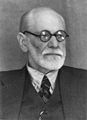 |
Sigmund Freud first identified the
process of transference ... he noticed that some patients reacted to him
as though he were their father, and that some female patients seemed to
fall in love with him. Freud concluded that his patients were
unconsciously transferring feelings and attitudes from earlier relationships
onto him. These interpretations formed a basis for what Freud later called
psychoanalysis. |
Freud defined countertransference in The
Future Prospects of Psycho-Analytic Therapy (1910) as a therapist's
emotional entanglement with a client, and "a result of the patient's
influence on [the physician's] unconscious feelings". We have expanded
this and added ways to dissolve them.
Getting Junger
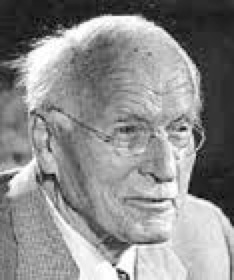 |
Carl Jung indicated in The Psychology of the
Transference (1946) that people in transferences and counter-transferences
often experience conflicts, and that the ability to endure the tension of
those conflicts without abandoning the experience allows people to grow and to
transform.
Jung warned against 'cases of
counter-transference when an analyst really cannot let go of a patient ...
both fall into the same dark hole of unconsciousness'. |
Freud wrote in his Introductory Lectures to
Psychoanalysis (1917) that in his
first meeting with Carl Jung, that he
asked Jung what Jung thought of transference.
Jung replied, 'it is the alpha
and omega of the analytic method'. Freud responded,
'Then you have
grasped the main thing.'
Common Transferences
There seems to have been an enormous amount of highly paid time and
energy expended on how exactly to define transferences ... and a much
smaller amount on how to manage and end them!
You meet someone and you immediately feel that "this is
going to be fun" ... or perhaps ... "I must be cautious".
Do you assume that your feelings are accurate assessments of other people? The most
difficult people in your life may be those people who reflect your transferences!
|
The wife of a colleague was friendly until
I started talking, and then she suddenly withdrew.
I asked what was happening and her voice became childish and angry. I asked
her who I reminded her of. She said, "Oh no - my step-father!".
I asked if I looked like him, and she said, No - but he was British like you
- and you have a similar accent - I am sorry - I suddenly felt that you
were him!". Martyn |
If you react to a transference by being overly friendly
or overly unfriendly, your actions will affect the other person's behavior
towards you. Then your transferred feelings about that person can become
self-fulfilling. (And you may become more convinced in the accuracy of
your intuition or gut feelings.)
|
A female student was staring at me
with wide eyes. During a break, I asked her who I reminded her of. She
said, "Nobody ... no ... wait ... you remind me of my first
boyfriend!". I asked, "In what way?", and she said,
"Strange - you walk in the same way. Now I feel
very sad that you
are not him. There is so much I want to tell him".
Martyn |
Transferences are likely causes of a person suddenly
becoming resourceless or resourceful during a meeting. (People may also
create transferences with pets, cars, computers etc). Some people refer to
transferences as positive or negative.
- A positive transference may describe an
inappropriate pleasant reaction
- A negative transference may describe an
inappropriate unpleasant reaction
Both can have toxic consequences, regardless of your
feelings. Both motivate inappropriate behavior, such as falling in
love or falling in anger. Both are common. In our coach
training we discuss and demonstrate many types of transference, and
teach conversational ways to dissolve transferences.
Common Signs of Transference
Transference indicates a blurring of identities that can
degenerate into arguments, affairs or codependence. You can test for
transference, by asking yourself if this person would behave in the same way with a lawyer or bank manager. And
ask yourself how might your behavior be different if this
person was of the other sex, younger, older or less interesting?
Here are a few common signs of positive and negative transferences from
newly-met or
little-known people. The key phrase is inappropriate behavior, regardless
of the pleasure of the transference.
|
Positive Transferences |
Negative Transferences |
- attempt to touch you
- overly complimentary
- offer inappropriate gifts
- tell you intimate details
- try to engage you
in conversation
- frequently ask personal questions
- ask for help with personal
problems
- say that you remind them of
someone
|
- avoid you
- overly critical
- offer cold comments
- avoid intimate details
- avoid conversation
- avoid personal questions
- avoid personal
problems
- say that you remind them of
someone
|
Transference has much in common with
projection, where people project their confusion or biography onto
other people, thus distorting how those other people appear. But everyone does
that! Exactly!
Double Transference Loops
Transference loops seem to be common in all human relationships,
and perhaps pose a particular risk to partnerships and teams. Transferences can
motivate unexpected
romances, relationship conflicts and hidden agendas. Just observe when people
become spontaneously and inappropriately friendly, resourceless
or irritated towards each other.
|
Transferences* and transference loops**
are based on responding to people as if they were other people.
Many relationship difficulties are based on such mistaken identities.
* Transferences manifest as moods, excuses,
complaints, blaming etc. Our coaching can dissolve transference
loops and move on without wasting time or losing momentum.
** Transference loops refer to people
trapped in simultaneous transferences about each other. People who wish
to dissolve transferences and transference loops peacefully
and quickly can benefit
from our couple
coaching and
team training . |
Participation in a partnership or team often begins
with positive transference loops (inappropriate pleasant feelings)
- and often ends with negative transference loops (inappropriate
unpleasant feelings).
|
You noticed that
whenever my husband rubbed his nose, I would become irritated. I hadn't
realized that this reminded me of my father. Then we discovered
that my way of showing irritation reminded my husband of his grandmother, who he
liked very, very much. No wonder our communication
sometimes got totally crazy. England |
Many people who fall in love are in this category,
projecting childish pleasures and disappointments onto each other. Later, when
transference loops end, the couple may not remember why they loved each
other, crying "What did I ever see in him / her?", "I must have been crazy!" and so on.
Dissolving Transferences
We teach six basic types
of transference, and ways to dissolve them in everyday conversation (for
short-term change) or during our in-depth coaching (for long-term change).
We do not try to dissolve transferences logically,
rather we coach people to recognize and interpret their transferences themselves. Conversational
solutions help people become aware of a transference and choose more appropriate
responses - but such solutions rarely last. Our systemic coaching solutions help people
change their automatic or subconscious emotional reactions.
Where there are transferences, there will be reactions to
transferences by other people. If the reactions are also transferences, we call the result transference loops.
Transference loops seem to be almost inevitable during long-term relationships
and can cause massive suffering.
|
I married a man with my father's problems
... I tried to rescue him. My husband realized that he didn't love me so much as a woman
... he saw me more as a daughter. You helped us love each other for our
qualities instead of our baggage. Calgary, Canada |
We help people quickly dissolve transferences and double transference loops
during our online coaching.
(The ability to recognize and dissolve
transferences and double transference loops appear critically important for
partners and team leaders, and for professional relationship management.)
Transferences & Transference Loops Part 2
Sharing thoughts and feelings is
relationship first aid. We help people make healthy relationship
decisions. Do you want to dissolve transferences and improve your relationships?
Online Coaching & Mentorship
Transferred References
Carl Jung: "The Psychology of the Transference",
1946, Princeton University Press, ISBN 0-691-01752-2
Herbert A. Rosenfeld: "Impasse And Interpretation",
1987, Taylor & Francis Ltd, ISBN 0415010128
Heinrich Racker: "Transference and Counter-Transference", International
Universities Press, 2001, ISBN 0-8236-8323-0
Harold Searles: "Counter-transference and related subjects.",
International Universities Press, 1979, ISBN 0823610853
Plagiarism is theft. Copyright © Martyn Carruthers
2007-2012 All rights reserved
|