But volunteers - even those who who lack emergency skills - can provide a
wonderful service to displaced people and immigrant refugees. See
Soulwork Africa. More below.
Important factors when managing displaced people:
- Local terrain, climate and season
- Their languages, dialects and history
- How many men, women and children
- Their economic background and skills
- Their cultural background and religions
- Their economic and political constraints
- Their physical condition and mental health
- Their expectations of government agencies
- Local infrastructure: buildings, electricity, water
and transport
Refugee camps
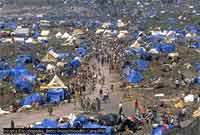 |
Short term refugee camps often use sheltered locations,
for example sport stadiums. Longer term camps may be chaotic - or may be
based on model villages. Relief agencies can assist and empower displaced
people to select community representatives to make communal decisions; both as a
basic human right and to help protect refugees from both internal and external domination.
Photo: Rwanda Refugee Camp |
The Dark Side
Life in a refugee camp can challenge physical and mental resources.
Some camps are organized like penal colonies, with all aspects of
life regulated. Refugees may be blamed for all problems arising in
and near these camps; and refugees deemed "problematic"
may be forcibly returned to hostile conditions. When refugees
provide forced labor, the differences between refugee camps and
concentration camps becomes blurred.
Example
In 1991-1992, about 250 000 Rohingya Muslims sought
refuge in Bangladesh from the Burmese army. The majority were forcibly
returned to Burma. Around 20,000 refugees remain in Bangladeshi refugee
camps. The United Nations provide dry food, clothes and cooking fuel,
although refugees do not consider these resources to be adequate. People
live in congested spaces with limited water. About 60% of children and 50%
of adults are reported to have malnutrition. Refugees are not allowed to
seek work or any other activity outside the camps. All education was
forbidden for four years. Since 1996, schooling is allowed in some camps.
The refugees provide reluctant forced labor. (Choudhury R. Abrar,
University of Dhaka)
(
Rohingya refugee camps)
Alternatives
An example of an alternative approach to refugee management is Guinea’s
policy towards refugees from Liberia and Sierra Leone. Refugees were allowed
to settle in villages and were given access to welfare services,
reinforced by international relief. This approach was beneficial
for both local and refugee populations and cost a fraction of refugee camps
– an estimated US$4 per refugee per year compared with US$50 per year for
camp-based medical programs. (S Gainsbury, University of Sussex)
4. Refugee Conflicts
Conflicts can be predicted - both between refugees and between displaced
persons and other communities - which include banks, merchants,
corporations or government agencies. Appropriate training can prepare
community leaders and relief agencies to assist in their resolution.
- Displaced people are under stress and are likely to be exploited (e.g.
the American slave trade and the abuse of Texas and Oklahoma farmers who migrated
to California in 1935-6).
- Governments and corporations may try to eradicate traditional
values (E.g. the historic treatment of native American Indians, native
Alaskans and native Hawaiians).
- Displaced people may not consider economic rationality and
oppose marketing efforts. (E.g. many Middle Eastern refugees ridicule
Western consumer values and economies)
- Refugee farmers may be coerced to buy fertilizer and pesticides,
but the increased production may only pay for more fertilizer and pesticides.
5. Refugee Trauma
Trauma refers to the consequences of harm, alienation,
witnessing horrible events and losing family and/or possessions. People may
express inner trauma as "outer rage"; and their internal chaos fuels
external chaos. If economic wealth
masks spiritual poverty, a lack of wealth may expose deep insecurity. By
contrast, people who find inner peace better tolerate and survive suffering
and the threat of death. Solutions for trauma and PTSD require empathy, care and
patience. (Read Viktor Frankl).
- Loss of freedom and human rights
- Insecurity about basic survival needs
- Being unrecognized and unappreciated
- Post Traumatic Stress Disorders (PTSD)
- Consequences of injury, disease and malnutrition
6. Refugee Coaching and Mentorship
As crisis fades, displaced people return to their homes, build new communities
or relocate. Professionals and volunteers can provide enormous assistance. The best
mentors are often people who were once refugees themselves, especially
if they are trained in coaching and mentorship. (We provide
professional coach and mentor training - internationally).
Many countries accept refugees, and many of these people will need coaching
and training - in languages, in community procedures, in new skills and in finding
work. Coaches and mentors can assist and solve many problems. Simpler coaching
skills, suitable for many volunteers (including teenagers), include:
- opening new perspectives
- finding reference materials
- finding appropriate information
- being a friendly contact person
- motivating, stimulating and inspiring
- observing behavior and offering feedback
More complex coaching skills can be offered by trained systemic coaches:
- resolve identity loss
- define and plan realistic goals
- identify and improve expert strategies
- identify and dissolve emotional trauma
- find inspirational mentors for important goals
- identify and disconnect from toxic role models
- assess life situations in preparation for and during major change
- deal with "survivor guilt", other unpleasant feelings and inner
conflicts
- untangle chaotic relationships (including relationships with
people who died)
- identify and change toxic beliefs (and relationships
that require toxic beliefs)
We teach these coaching skills in our
Systemic Coach Training.
Refugee Resettlement
Home visits and offices can be run by volunteers to assist many refugees. Volunteers
can solve simple problems and refer more complex issues to trained staff.
Integration programs can include three phases. A) intense coaching
for the first three months, B) six months of less intense coaching,
and C) three months that encourage self-sufficiency.
Resettlement staff can ensure that refugees receive housing,
food, clothing, transportation, medical aid and employment. They help
ensure that isolated refugees are contacted and that people showing signs of medical,
psycho-social or psychiatric problems are referred to appropriate agencies.
Resettlement staff can also help protect refugees from unscrupulous vendors
and salespeople. They can refer more complex issues to trained staff. Complex
issues include finding durable solutions for unaccompanied
children, child soldiers, people with disabilities, education,
child and adolescent health, exploitation and sexual abuse.
After a year or so, displaced persons can themselves receive systemic coaching,
and receive added direction, motivation and inspiration; with the option of
a more casual relationship with the coaching staff - and with some refugees
perhaps becoming refugee coaches themselves.